
Preparing for 26.2
A year of miles and small gains

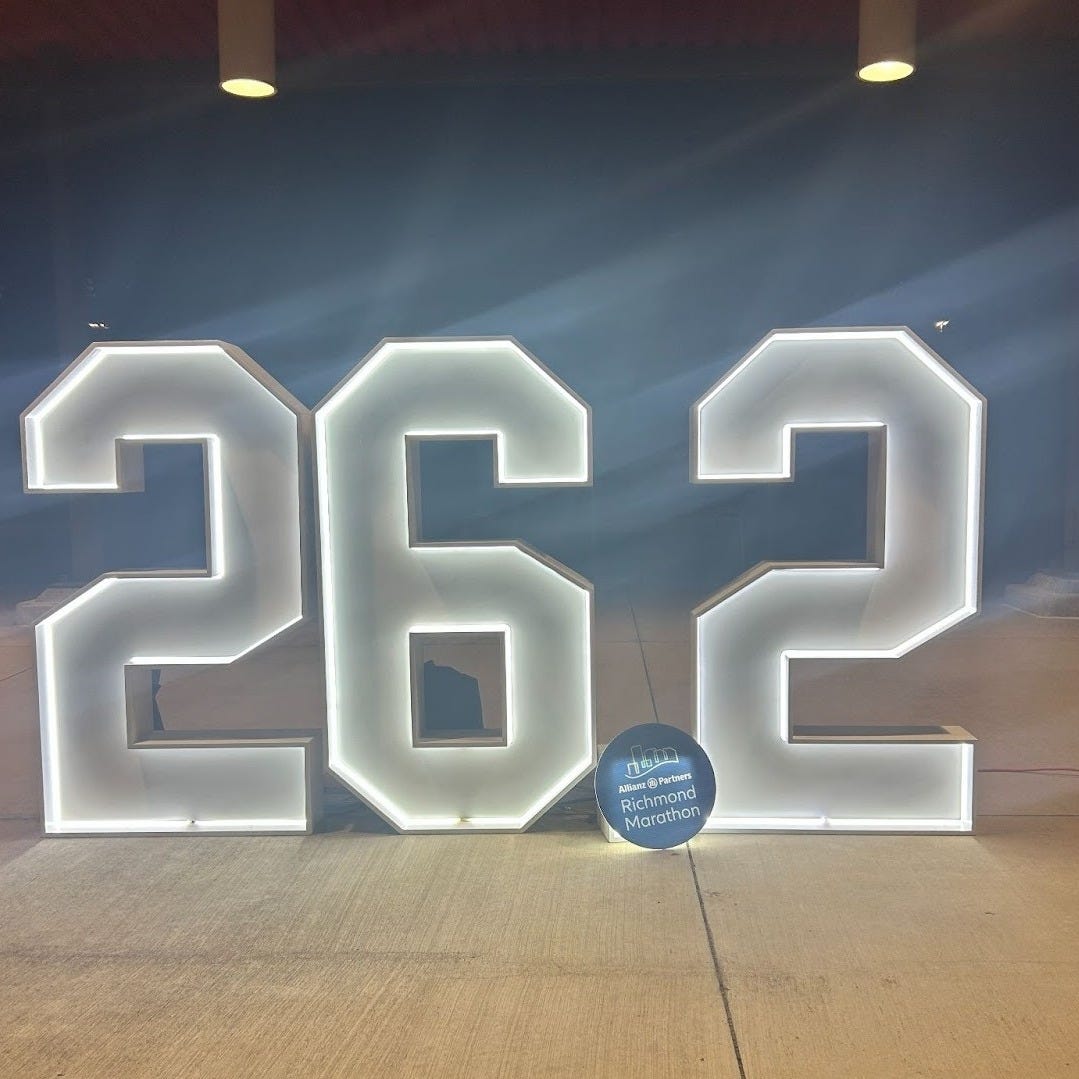
By the ordinary logic of life, you would expect to come out changed after running 26.2 miles. At least when you do it for the first time. It was for me. I gained a respect for the distance grounded in the fact of bloody, detached toenails, and the blunt testimony of my body’s unyielding besieging hurt in the full length of my legs. Neither standing up, nor sitting down, nor lying down offered any relief in the hour or so after the race. It is an experience I liken to your legs immobilized over a colony of fire ants, and these famously truculent red ants have an unfettered way with you. Short of leaving my own body, I could do nothing to bypass this fiery final stage of the experience.
This was intimate knowledge of the distance, firsthand knowledge not drawn from secondhand tellings that acquired an aura of myth as I heard them before going the distance.
This was in 2022.
For my second attempt at the distance, I signed up for the 2025 Richmond marathon upon crossing the finish line of the 2024 half-marathon on November 16th. At least it seemed so. In reality, it was four months later in March, 2025.
Sports Backers, the organizer of the races would already be sending email promotions for the 2025 edition the week after the 2024 races, offering slightly reduced prices — easier on the pocket, but nowhere near enough to assuage the demands of the training and race day itself. If the fee can be cheaper, nothing else comes cheap. The miles are still long. The fatigue is still heavy. Race day still lays out 26.2 miles stretched before you up and down the streets of Richmond, and over two bridges across the James River.
Early bird discounts are a lure into a world of self-questioning and buyer’s remorse for what seemed like a great idea at the time of signing. However, the catalog of difficulties is not the final word. The euphoria and sense of accomplishment on finishing the race that will last for life are priceless.
Thus, for much of the year, every bit of exercise I did felt like part of getting ready for the November marathon. Every bike ride, stationery or road bike, every gym workout was an installment toward the requisite fitness for the cause, a deposit in the marathon bank. More so, every run came with questions of how much the distance I covered compared to a marathon — that was the important measure.
Early in the year, training distances were far short of 26.2. That was ok. I only needed to do enough to have a solid base around the end of August when race day was about 12 weeks away, and I would look into starting a structured training program. I used one of Hal Higdon’s training programs. The structured approach allowed me to build up to twenty miles from twelve, fourteen and sixteen miles every other weekend.
Though along the way, I made mistakes that I felt kept the training from fully adding to the endurance and strength I was building up to.
A notable error was my choice to explore the Buttermilk Trail around the James River, hitherto only a name to me, when my training called for sixteen miles. Running on a rugged, technical, rooty and rocky trail sabotaged an important session in the season.
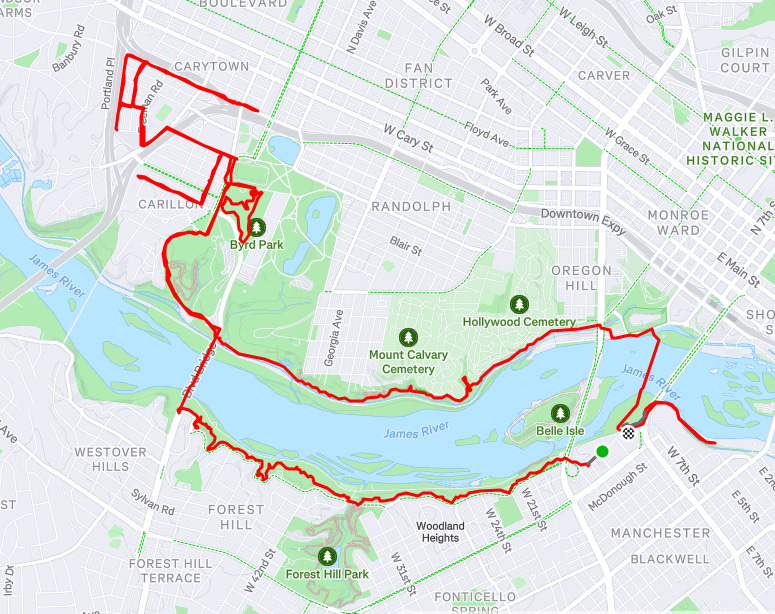
Training on a trail I had never run before was driven by a wish to break the monotony and see more of the James River. Much of it was too technical for steady running. I slowed well beyond my target of ten minutes a mile and, in places, had to walk. The Friends of the James River Park website describes the trail in detail.
The trail parallels the south side of the river and is a real challenge and considered the most difficult of the different sections of the James River Park System. Buttermilk combines tight, twisty, fast descents and steep climbs with lots of rocks and roots. Several creek crossings and some bridges and rock gardens add character to one of the most beloved trail systems in the Richmond area.
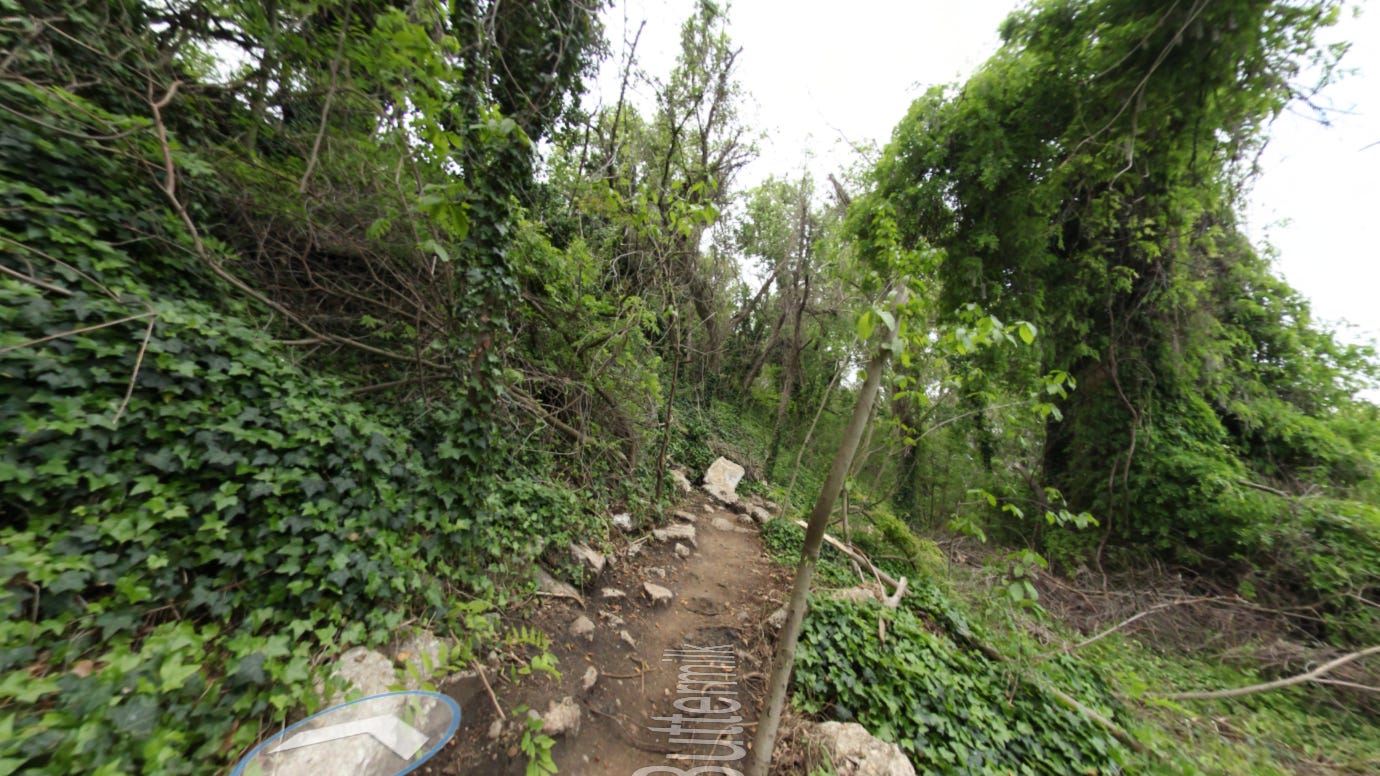
This was on my out run.
On the back run, I had to traverse the North Bank Trail, another trail I had not been on. Again the Friends of the James River Park website description of the North Bank Trail draws parallels with Buttermilk Trail and describes it in much the same terms.
Like Buttermilk, North Bank is an advanced trail that is technical, rocky and rugged in spots. Fast, flowing singletrack with some steep climbs and fast descents – users should be careful of oncoming mountain bikers and pedestrians. This trail offers great panoramic views of the James River unavailable in other sections of the Park. The trail runs from the Boulevard (Nickel) Bridge west to Tredegar Iron Works parking lot.
For a long-run session to lead to an increase in overall fitness and endurance, the run must keep faith with the goals of the day’s training. At the end of the session the body must feel it reached new physical-strain territory during training. Tell-tale signs of lingering muscle aches in the next day or two are signs that I would reap the benefits of that training.
When it came to the race itself, it was a better experience than my first marathon in 2022. I felt prepared, I hydrated and refueled throughout, the weather was ideal if you were not overdressed like I was through the first half of the race (I needed it during that first part), and I had better fitting shoes. One week after the race, it did not seem like any of my toenails would fall off.
It being the second time doing 26.2 miles was key to how I felt. It was now a largely familiar nemesis. I knew at some point I would question my ability to finish the race at all without even thinking about finishing with a good time. It would get really tough. But I also knew it was survivable. I had done it once and lived to tell about it. There was comfort in that.
This second time, I did not pass through the same range of emotions that marked my first marathon. Then, I felt raw dread at the start line, a sense that the whole endeavor bordered on insanity. I carried a nervous energy into the early miles because the full 26.2 was still unknown to me. Between the 10K mark and the half-marathon point, I began to think it wasn’t so bad. These were respectable miles covered with enough energy left to feel optimistic. Approaching twenty miles, that optimism frayed into the question of how, in any reasonable sense, I was supposed to cover six more. After limping into the twenties, all I could do was hold on and try not to let my face twist into unfamiliar grimaces.
Going back to the premise at the beginning of the essay that finishing a marathon is transformational — experiencing an activity firsthand demystifies the mystery the activity might hold for you. It actually demystifies people: the masters and demigods of the activity. At its very basic, a marathon is about human nature. It’s a journey of self discovery which is a stand in for discovering people.
There are the professionals whose intense running and pace make the rest of us look like Galapagos tortoises crossing a beach. Having run the distance, I am in awe of someone who can run every mile of the 26.2 miles at a pace of 5:21 minutes per mile as did the winner of the 2025 edition of this race. But this awe is tempered with the knowledge that these are human feats, not those of aliens just landed to show off by burning the soles of their Brooks or New Balance trainers on the asphalt and cobbled streets of Richmond.
There are ordinary folks running besides you. All with different strategies for overcoming the onset of fatigue and focusing the mind away from the present build p of fatigue. The petite lady from Charlotte NC who causally conversed, told me about the City of Oaks Marathon in Raleigh NC. She greeted every dog owner cheering us from the curb, and she thanked every police officer she came across, “for being here.” Then as suddenly as she started the conversation with me, she dropped off and disappeared in the wake. Only to appear a couple miles later passing me on the other side of the street ever so slightly but forging ahead.
The septuagenarians and older whose bodies seem to have acquired running gaits that make it seem they are in perpetual pain; and there are those who bear messages on bibs or running shirts, running in memory of someone, and those who wear full costumes. Batman for instance who seemed to be getting “Go Batman” cheers from every person on the course. How I envied him for each of his endless shots of encouragements thrown his way while we kept pace.
And there are the fans: playing music, live bands or sound systems, official and nonofficial fueling stations offering everything from water, nuun, pickle juice, energy bars, to shots of liquor, bacon, wine and beer — a marathon is such serious crying business a certain dose of levity on the part of the runners and spectators is mandatory to fulfill such a masochistic activity.
There is no doubt of the physical transformation when one completes a marathon. There is also a renewal of the spirit and mind that attends the feat. It is in the training for the race and the chosen communal suffering with others cheered on by thousands who could be sleeping-in or be in the comfort of their warm beds on a 40 degree Saturday morning or watching football or doing whatever their Saturday morning ritual happens to be.
All this, at least for a time, renews my belief in us humans, washes away the cynicism for a spell. This has a way of re-centering my spirit and getting re-grounded. They say addiction is chasing the experience of the first high. Perhaps that is why I keep signing up: not for mere punishment, but for the reminder that we are still capable of showing up for one another, for a renewed sense of self and a new lease in my belief in humanity.
A source of much needed mental stimulation tonic. I have found your writing to be a source of soul-refreshing elixir.